WHEN SOUND COLLAPSES: WHAT THE REAL TEACHES
By Andrea
There are these moments when everything finally seems to hold.
VERSION FRANÇAISE SUR SUBSTACK
VERSION FRANÇAISE SUR SUBSTACK
You sit down. You’re not really waiting anymore. The body relaxes almost despite itself. Gestures become rarer, more precise. You no longer touch the settings. You listen. You let it come. Nothing’s pressing.
The file was working.
After hours of listening, analyzing, deciding, going back, silent doubts and micro-adjustments, the piece had found its form. Recordings from the Taiwan port layered over synthetic textures, a fragile but coherent architecture. Each element seemed to have found its place, not through evidence, but through necessity.
On my computer, with my studio monitors, in the controlled silence of my workspace, everything held. The piece breathed. It had its internal rhythm, its discreet tensions, its zones of waiting. Nothing overflowed. Nothing was missing.
At that precise moment, you believe the work is finished.
Then I tested it on the diffusion system of the venue where I was going to perform.
The collapse was immediate.
Not spectacular. Not brutal. Something that lets go, all at once, without warning.
The bass frequencies I had patiently shaped transformed into indistinct mass. The details, though present, dissolved in the space’s reverberation. What held in the intimacy of listening crashed against the materiality of the place — walls, volume, the muffled resistance of air.
It was no longer the same piece. Perhaps it never was what I believed.
The real had just judged. And it had said no.
I. THE PHILOSOPHER’S MISFORTUNE
Paul Valéry writes in Eupalinos or the Architect:
“It is thus in all domains, with the exception of that of philosophers, whose great misfortune is that they never see the universes they imagine collapse, since after all they do not exist.”
This sentence imposes itself slowly. It doesn’t convince. It insists.
It draws a simple line, almost cruel, between those who build in matter and those who build in abstraction.
Architects see their buildings yield. Sculptors feel the stone split under a misplaced gesture. Musicians hear their compositions disintegrate as soon as they encounter real space.
Philosophers can remain sheltered for a long time. Their conceptual universes can be coherent, elegant, closed on themselves, without ever being confronted with the world’s resistance. This is what Valéry calls their “great misfortune”.
I don’t have that luxury.
Sound doesn’t permit illusion for very long. It cuts. It exposes. It decides.
“This test of the real isn’t a sanction. It’s a lesson.”
II. REBUILDING FROM THE COLLAPSE
When the composition collapsed in that room, it revealed nothing new. I’ve worked long enough to know the room always waits. In the shadows. Ready to cut. Sometimes with regret: “You were wrong, here the rules are altogether different.”
It exists somewhere. It encounters a space. It collides with materials. It crosses bodies.
I had composed in the intimacy of the studio. A controlled space, silent, where nothing resists. But I always compose for an intimate exchange — like speaking to a friend. And that intimacy demands the right room. Forty people or three hundred and fifty, it changes everything. The air vibrates differently. Bodies absorb, reflect. The room lives, moves.
Speaking intimately in an inappropriate space distorts the entire message.
I had to start over from the room itself. Not in urgency. In listening. Walk slowly. Stop. Clap hands. Listen to how the space responds, where it absorbs, where it reflects. Test the zones where bass gets lost, those where highs find an outlet.
Reposition the speakers. Readjust the frequencies. Delete entire layers. Accept losing what had nevertheless “worked” elsewhere.
When I relaunched playback, something had changed.
The sound held. It was no longer just coherent in theory. It existed in this precise space.
This is the difference that runs through my work. I can’t think sound from a distance. Each recording can fail. Each performance can come undone. The mic, the place, the body’s attention, everything participates.
“This fragility isn’t a flaw. It’s a discipline.”
III. WHAT THE BODY KNOWS
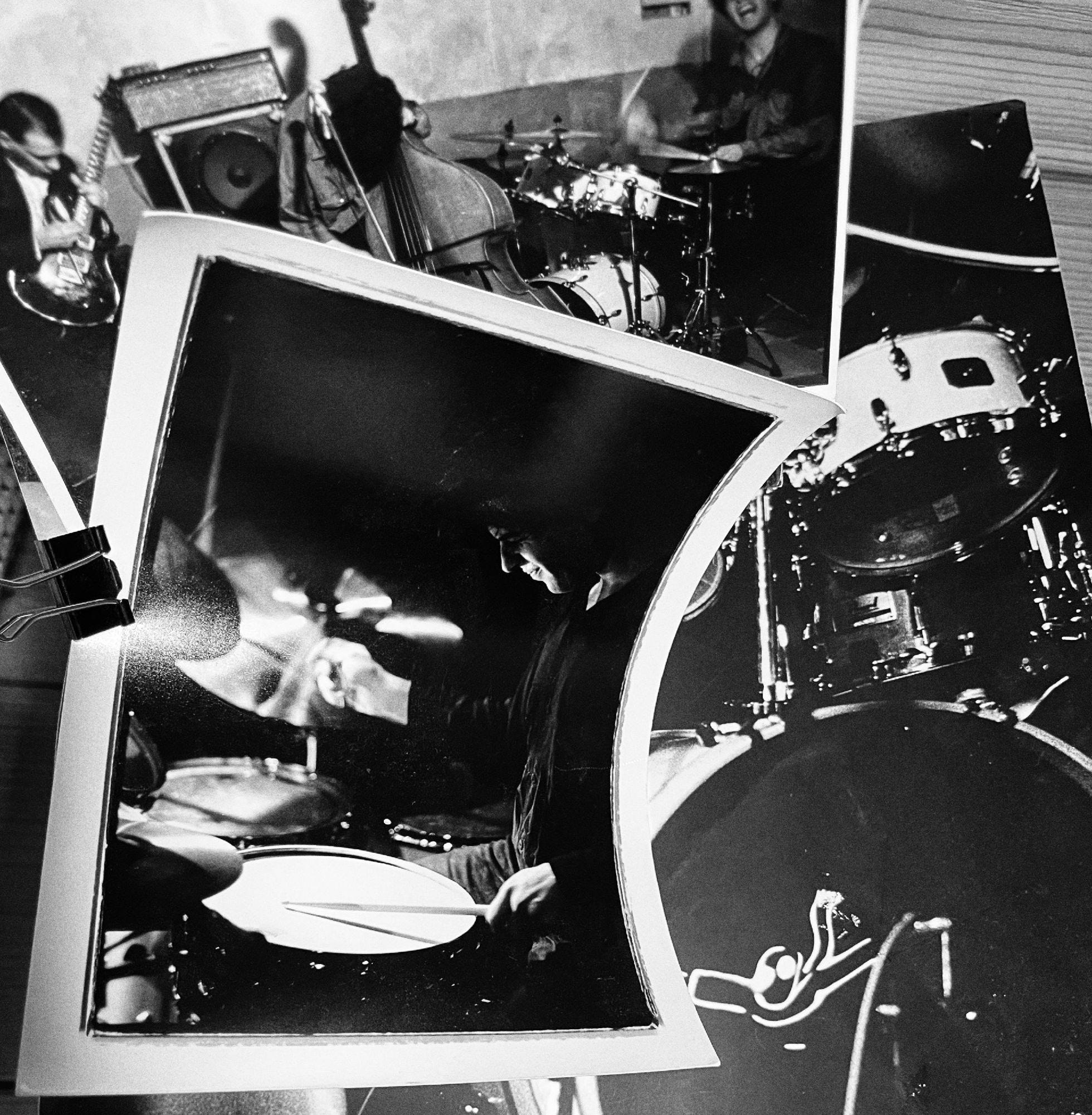
Thirty years of drums, forty years of martial arts: the body doesn’t lie.
An uncertain strike doesn’t hide. It’s heard. Sound reveals what the body sometimes tries to mask. In a randori, you can’t simulate presence. The opponent immediately senses if attention wavers. Their weight shifts. Their breathing changes. Everything is perceived even before movement.
And the other acts immediately. If my posture wavers, my partner doesn’t let the opening pass. What we are, even for an instant, directly touches what surrounds us.
An exigency settles: what doesn’t hold bodily can’t hold conceptually.
Then the tinnitus arrived.
Progressively. A high-pitched whistle that settles and never leaves. Around 8000 Hz. Always there. Faithful. Imperturbable.
At first, I tried to fight it. To find “my old silence” again. Then I understood it wouldn’t leave.
I had to relearn listening from this altered body. Accept that there no longer exists for me a supposedly neutral ear. I must constantly distinguish what comes from outside from what resonates inside my skull.
When I compose now, I must actively filter this phantom frequency. This question returns endlessly. It slows the work. It obliges patience.
But this constraint has become a tool. A vigilance. A daily reminder that all listening is situated. Each person listens from their history, their wounds, their limits.
The tinnitus forces me to assume this truth I could once ignore.
IV. THE FERTILE COLLAPSE
What I’m developing takes root here. Not elsewhere. Not in books first. Here, in these repeated collapses.
Not to illustrate concepts with sounds. Not to apply theories to a practice. But to accept that thought itself is subjected to the test of the real.
Through my readings, my research, my questioning — these concepts don’t remain suspended in abstraction. They descend immediately to the field. Either they hold against the complexity of the real. Or they yield.
And when they yield, it’s not a failure. It’s information.
The theory then shows me where it doesn’t suffice. Where the real resists abstraction. Where something else must be thought, experimented.
The fertile collapse is perhaps the heart of my practice. Accepting that my sonic universes can crumble. That my hypotheses are contradicted by a space, a body, a moment.
And rebuilding from there. Not in urgency. Not in panic. With patience. With humility. With the conviction that the real, even when it says no, always teaches something.
FOLLOW
Listen: SoundCloud — Insta: @andreavalvini — More: Gesturestilllisten
This collapse in the performance venue taught me more than months of reading. The real judged, and I had to listen.
The questions continue: what does it mean to listen, to experiment? How to be part of a world in perpetual movement? How does the trace of the past indicate a direction to follow?
This is the path I’ll share in the coming texts. If this resonates, subscribe.
VERSION FRANÇAISE SUR SUBSTACK